
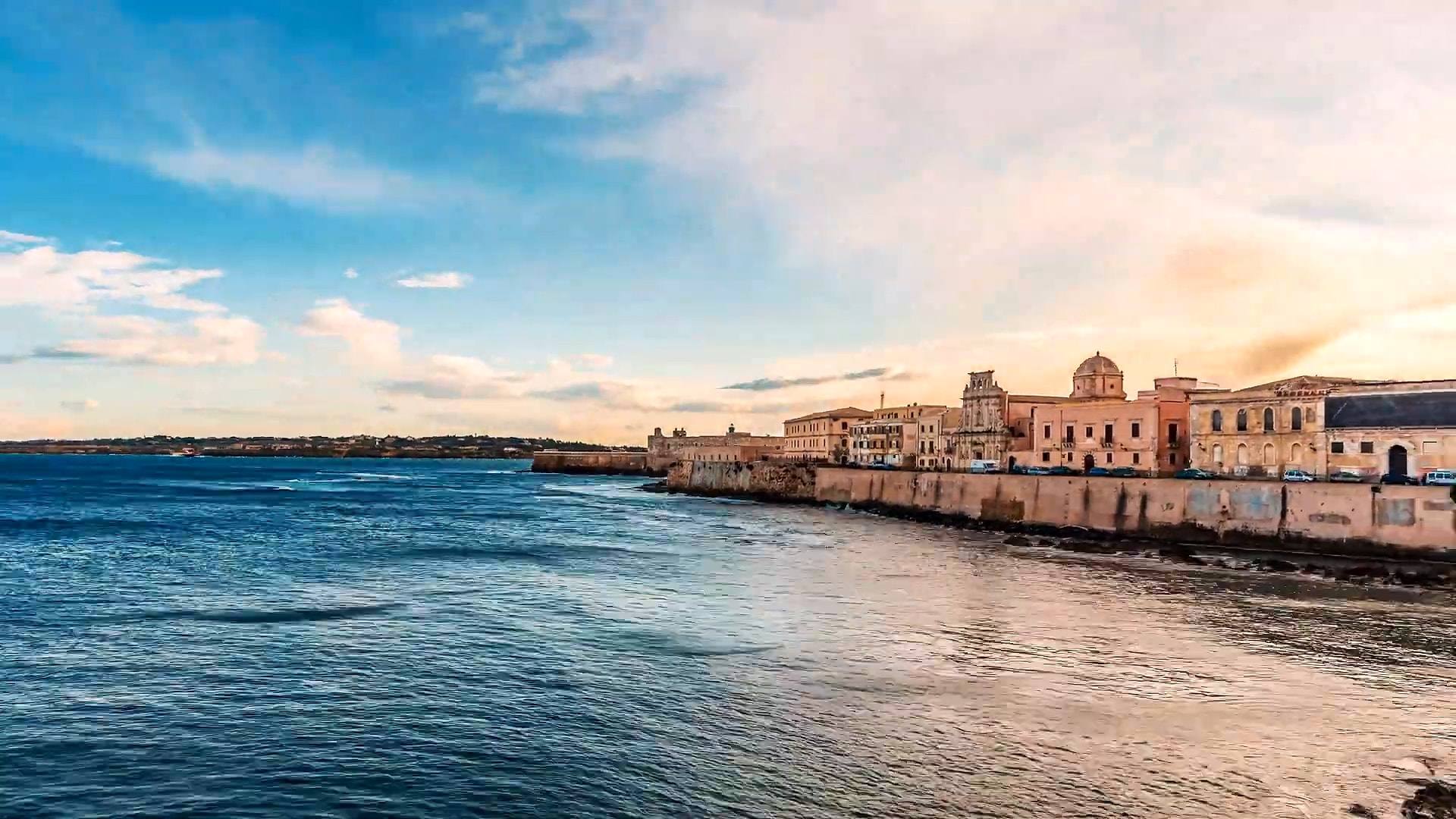
The eastern seafront of Ortigia with its buildings facing the sea

Ortigia on foot

Ortigia is the island where Syracuse began. It measures less than a kilometre and a half from end to end and is linked to the mainland by two bridges. From the B&B you can reach everything on foot.

Walking times from Via Dione 8, approximate.

  1. Squares and Baroque 1 min walk

    Piazza Archimede

    A 19th-century square in the middle of Ortigia, with the Fountain of Diana and elegant palaces all around.

    The square was laid out in 1878 and named after Syracuse’s great scientist, Archimedes. At its centre stands the Fountain of Diana, completed in 1907.

    Tip In the evening the lit fountain is very photogenic. It lies halfway between the Temple of Apollo and Piazza Duomo.

    Walking route
  2. Ancient Greece 4 min walk

    Temple of Apollo

    The first monument you meet entering Ortigia is the oldest stone Doric temple in Sicily.

    It dates from the 6th century BC and was dedicated to Apollo, as an inscription on the eastern steps records. Over the centuries it served as church, mosque and barracks, and was fully freed from the buildings around it only in 1938.

    Tip You view it from outside the fence, free of charge. Morning light is best; combine it with the nearby market.

    Walking route
  3. Squares and Baroque 4 min walk

    Ortigia Market

    Stalls of fish, citrus, spices and street food in the lanes by the Temple of Apollo. It is the liveliest introduction to Syracusan food.

    The open-air market winds along Via Emanuele De Benedictis and nearby streets, next to the 19th-century Antico Mercato building. It is seen as a showcase of local produce.

    Tip Go in the morning, when the market is at its liveliest and fully set up. Great for tastings and a quick sandwich.

    Walking route
  4. Giudecca 5 min walk

    Giudecca (Jewish Quarter)

    Ortigia’s medieval Jewish quarter, with narrow lanes, courtyards and traces of a community expelled in 1492.

    Syracuse’s Jewish community was one of the largest in Sicily until the expulsion edict of 1492. The quarter still holds ritual baths (miqwe) and, according to the prevailing theory, the site of the synagogue beneath the church of San Filippo Apostolo.

    Tip Explore it slowly on foot, ideally in the morning or at sunset; combine it with the Miqwe and San Filippo Apostolo.

    Walking route
  5. Museums and underground 5 min walk

    Puppet Museum and Theatre

    Paladins, armour and stage sets of Syracuse’s puppet opera, with the same company’s theatre just around the corner.

    The museum was founded by the Vaccaro-Mauceri association, uniting two Syracusan puppeteer families; the Mauceri brothers have staged puppet shows since 1995. The Opera dei Pupi is recognised by UNESCO as intangible cultural heritage.

    Tip Museum at Piazza San Giuseppe 32, theatre at Via della Giudecca 22. Check the show calendar on the official site and book ahead with children.

    Walking route
  6. Squares and Baroque 5 min walk

    Piazza Duomo (Cathedral Square)

    Ortigia’s Baroque square, with pale limestone, noble palaces and the cathedral front along one long, gently curved space.

    The square occupies the highest point of Ortigia, once the sacred heart of the Greek city. After the 1693 earthquake it was reshaped with the cathedral, Palazzo Vermexio, Santa Lucia alla Badia and other Baroque palaces.

    Tip At sunset and after dinner the stone glows warm, and that is the best time for photos and a stroll. Early morning it is almost empty.

    Walking route
  7. Ancient Greece 5 min walk

    Syracuse Cathedral

    A Baroque cathedral built inside a Greek temple. The Doric columns of the Athenaion still stand in its walls and aisles.

    The Temple of Athena was built between 474 and 460 BC and turned into a Christian basilica between the 6th and 7th centuries AD, its columns absorbed into the new walls. After the 1693 earthquake the façade was rebuilt in Baroque style; the cathedral is part of the Syracuse UNESCO World Heritage site.

    Tip Walk along Via Minerva to see the Greek columns jutting out of the side wall. Tourist visits may be paused during services; dress respectfully.

    Walking route
  8. Museums and underground 5 min walk

    Piazza Duomo Hypogeum

    Rock-cut tunnels beneath Piazza Duomo, used as an air-raid shelter in World War II, running down towards the sea.

    The route links Ortigia’s highest point with the Foro Italico by the Marina walls. Syracusans sheltered here during World War II bombings; it reopened after restoration in 2006 and again in 2014.

    Tip A short, cool visit, ideal in the hottest hours. Opening times vary, so ask at the entrance on the square.

    Walking route
  9. Squares and Baroque 6 min walk

    Church of Santa Lucia alla Badia

    Baroque church at the end of Piazza Duomo, dedicated to the patron saint Lucy; it housed the Caravaggio for years, now back at Santa Lucia al Sepolcro.

    Originally the church of a 15th-century convent, it was destroyed in the 1693 earthquake and rebuilt between 1695 and 1703. From 2009 to 2020 it displayed Caravaggio’s 'Burial of Saint Lucy', which since December 2020 is back in the basilica of Santa Lucia al Sepolcro.

    Tip Looking for the Caravaggio? It is no longer here, so head to Santa Lucia al Sepolcro on the mainland. The façade looks best from the middle of the square.

    Walking route
  10. Museums and underground 6 min walk

    Papyrus Museum

    A small museum devoted to papyrus, a plant that grows naturally in Syracuse along the Ciane river and at the Fonte Aretusa.

    It was founded in 1987 by Corrado Basile and Anna Di Natale and is run by the International Papyrus Institute, a non-profit cultural body. It displays papyri, objects and the techniques of papyrus paper-making.

    Tip A quick visit that works well with kids; pair it with the Fonte Aretusa to see papyrus growing.

    Walking route
  11. Giudecca 6 min walk

    Miqwe, Jewish Ritual Bath

    An ancient rock-cut Jewish ritual bath whose pools are still fed by groundwater, deep beneath the Giudecca.

    It is the miqwe recognised by the Jewish community, with three pools in the central hall and two in the side rooms, beneath the building on Via Alagona that is now the 'Alla Giudecca' guesthouse. It was rediscovered during restoration work begun in 1989; its dating is still debated.

    Tip Visits are by guided tour only, run by the property on Via Alagona, where you can ask about times and conditions. You go a long way below street level.

    Walking route
  12. Sea and fortresses 8 min walk

    Forte Vigliena

    A bastion facing the open sea on Ortigia’s eastern side, with waves, rocks and dawn light.

    Of the fortifications that once ringed Ortigia, mostly demolished in the late 19th century, Forte San Giovannello and Forte Vigliena survive on the eastern side.

    Tip The east side faces sunrise, so come early in the morning. In rough seas, keep away from the edge of the rocks.

    Walking route
  13. Ancient Greece 8 min walk

    Fountain of Arethusa

    A freshwater spring a few metres from the sea, with papyrus and ducks. It is the setting of the Arethusa myth and a symbol of Syracuse.

    In myth the nymph Arethusa, pursued by the river god Alpheus, was turned into a spring and resurfaced here; Pindar, Ovid and Virgil wrote of it. The pool hosts one of Europe’s very rare papyrus stands.

    Tip Admire it free from the balustrade. At sunset, with the sun over the Great Harbour, it is one of Ortigia’s most romantic moments.

    Walking route
  14. Sea and fortresses 8 min walk

    Cala Rossa (small beach)

    A tiny cove in the southern part of Ortigia, towards Castello Maniace, for a swim without leaving the old town.

    It is one of the very few small beaches on Ortigia, whose coastline is otherwise almost all rock or fortifications.

    Tip It is tiny, so in summer arrive early. Water shoes help; no beach facilities guaranteed.

    Walking route
  15. Sea and fortresses 14 min walk

    Maniace Castle

    Frederick II’s castle on the tip of Ortigia, between the open sea and the Great Harbour.

    It was built between 1232 and 1239 for Emperor Frederick II of Swabia, to a design attributed to Riccardo da Lentini. It takes its name from the Byzantine general George Maniakes.

    Tip Even without going in, the forecourt and the walk around it offer fine sea views. Hours and tickets change often, so check before you go.

    Walking route

Beyond the island

The Neapolis Archaeological Park, with the Greek Theatre and the Ear of Dionysius, is about 2.5 km away, 35 minutes on foot or a few minutes by taxi. Between May and July the Greek Theatre hosts its season of classical plays.

Message us on WhatsApp Call